
Since late September, anyone has been able to upload any image to our public verifier and read its provenance. We shipped it quietly, two weeks before we mentioned it, because a verification tool should exist before it is talked about. It has now sat under the launch announcement, the survival matrix and thousands of checks. This post is its proper introduction: what it does, the three results it can give you, and what each one honestly means.
What it checks
Add a file and the checker looks for Content Credentials inside it. It parses the C2PA manifest, if one is present, validating the signature and the timestamp against the trust infrastructure. Then it reports the result in plain terms: signed by Modelia, signed by another trusted signer, invalid credentials, or no Content Credentials found. Your file never leaves your browser.
It is free, it has no volume limit for ordinary use, it works on anyone's files, not just ours, and it does not keep what you upload.
The three results, and what each means
| Result | What it means | What it does not mean |
|---|---|---|
| Trusted & Verified | The file carries a valid signed record: what it is, who vouches for it, when. The strongest answer available. | It does not certify the image is a fair depiction of a product, or that the publisher's visible-label duty was met. |
| Not verified — Invalid credentials | The file carries Content Credentials, but they fail the check: the file was changed after signing, the signature doesn’t match, the certificate is expired or revoked, or the credentials are damaged. | It does not recover the full signed history; for that, the original export or the provider's records are the source. |
| Not verified — No Content Credentials | The file carries no readable marks. See the section below, because this is the result most often misread. | It does not mean the image is authentic photography. And it does not prove the image is AI. It means the file is silent. |
The three-beat demo
The fastest way to understand both the tool and the EU's two-layer design is one experiment, which we ran for this post and archived.
- Beat one.A fresh export from Modelia Studio, uploaded to the verifier: provenance verified, manifest intact, watermark present.
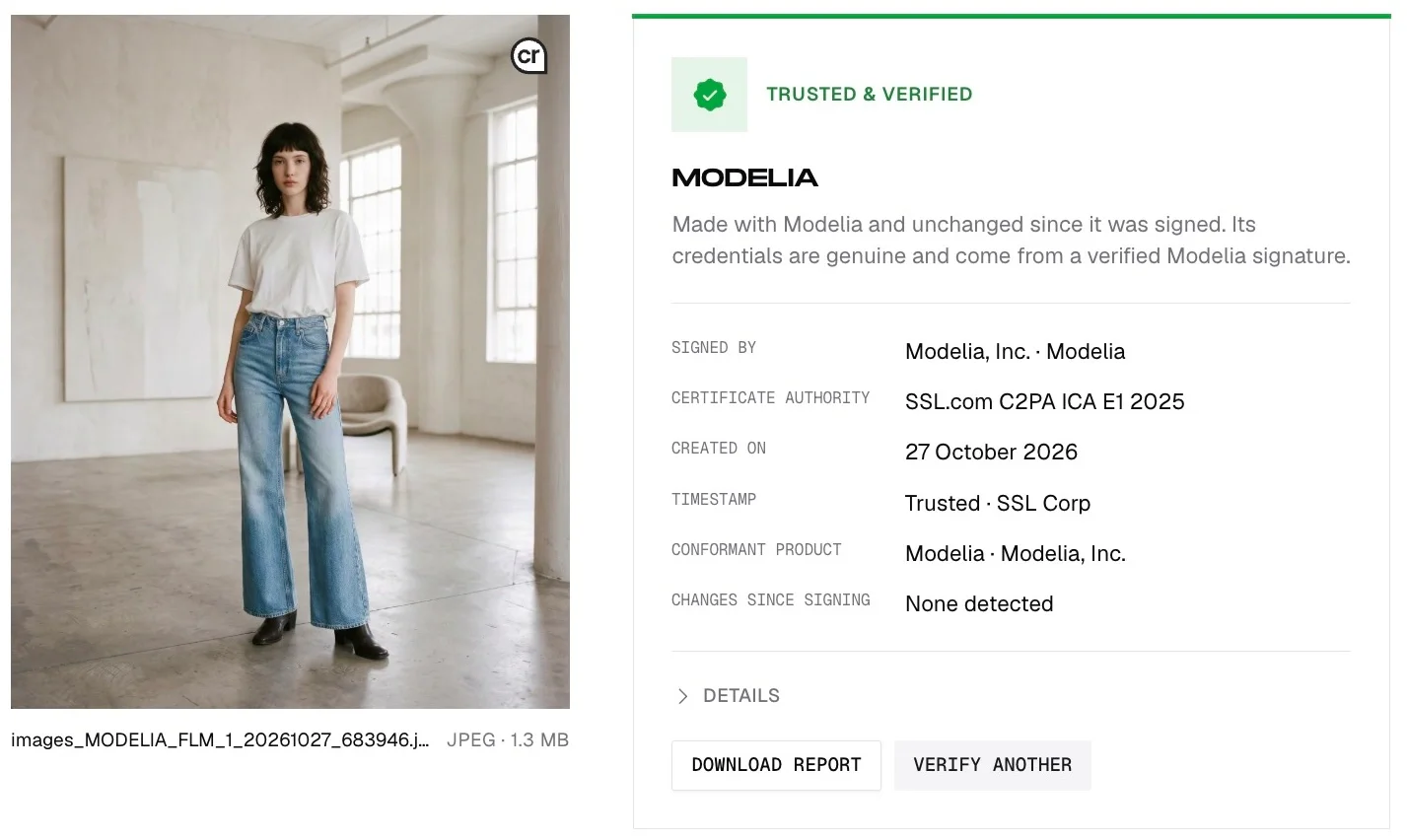
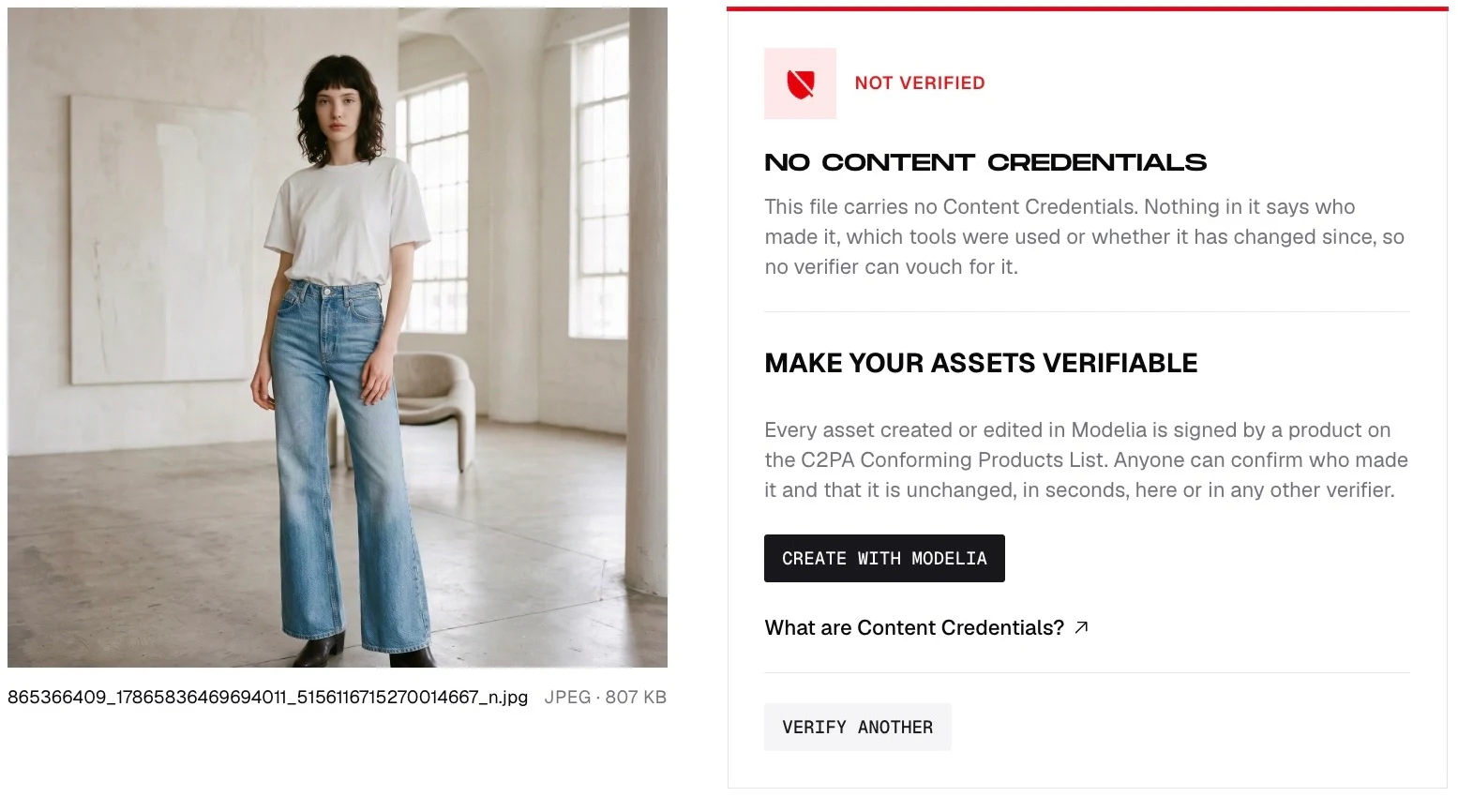
- Beat two.The same image published on Instagram, the public copy downloaded and verified again: manifest gone, watermark detected. The file lost its paperwork and kept its fingerprint in the pixels.
- Beat three.A screenshot of that public copy, verified once more: the verifier finds no Content Credentials. Whatever survives this beat is what survives the real internet.
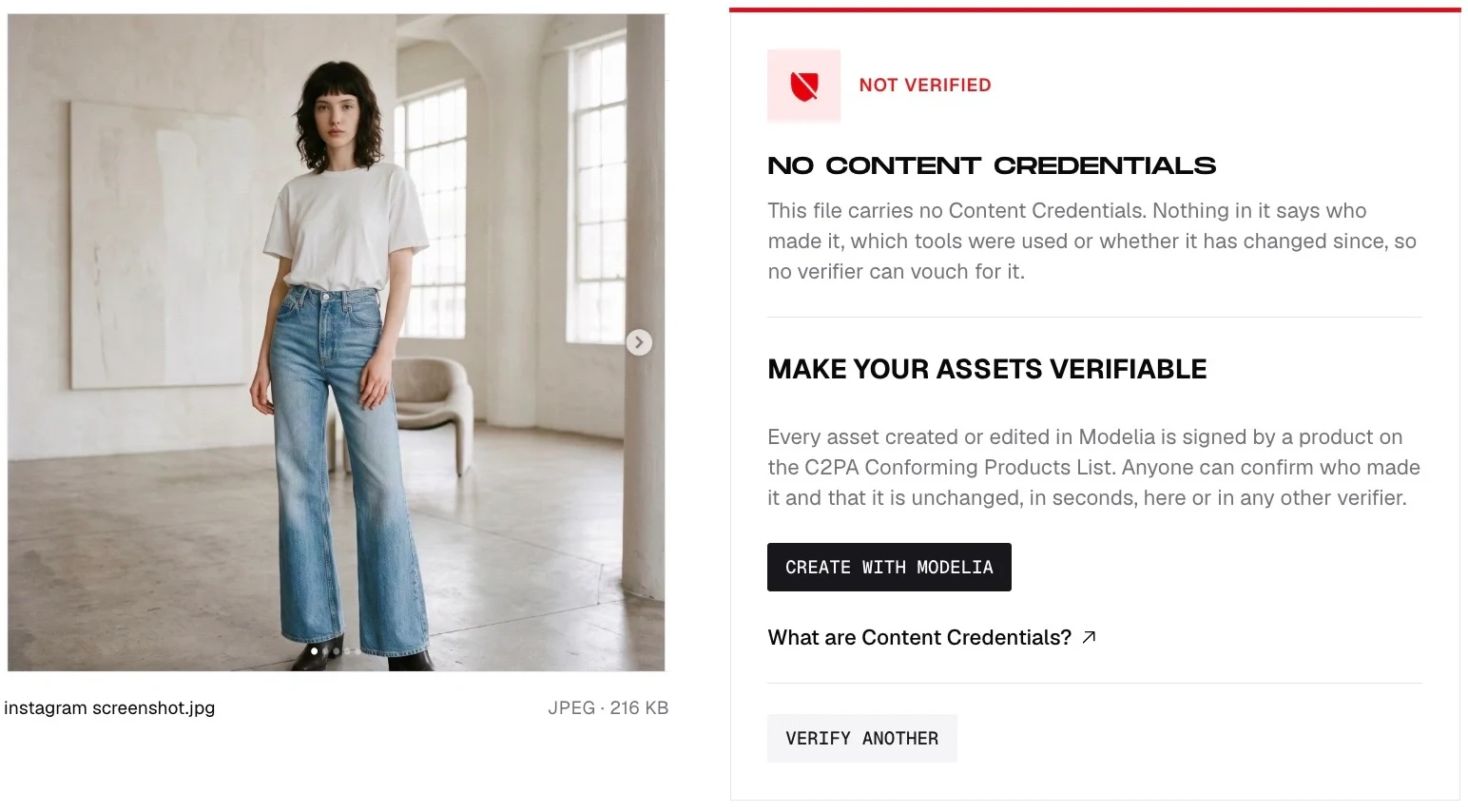
The pattern is the survival matrix compressed into one file's biography, and it is why neither layer alone was ever going to be enough.
When the tool finds nothing
The most common question since September is about the third result, so here is the honest reading. "No provenance found" means the file is silent: no valid manifest, no detectable watermark. Silence has several innocent explanations. The image may be real photography that never had provenance. It may be AI content from a system that marks nothing, which was the norm until recently and is still common. Or the marks may have been destroyed in heavy editing or repeated re-encoding.
What silence cannot do is certify anything. An unmarked image is not proven authentic, and it is not proven synthetic; today's forensic detection of unmarked AI content is not mature, whatever some tools advertise, and our verifier does not pretend otherwise. If the image is yours and you expected marks, the questions to ask are upstream: which system generated it, what does that system embed, and did an editing step destroy the layers. If the image is from a vendor, this is precisely what the ten vendor questions exist for, and what export records resolve in one lookup.
Who it is for
Everyone, deliberately. Brands auditing their own libraries or their vendors' claims. Journalists and fact-checkers, with free access and no account. Authorities, for whom independent verifiability is the entire point. Competitors, honestly: check our files, that is what the tool is for. Verification only changes behaviour when checking is easier than doubting, which is why it is public, free, and answers in seconds.
You can run any image through our C2PA Content Credentials checker. What travels inside a Modelia image, and what deliberately does not, is documented in what is inside a Modelia image, and the announcement that started the month is Modelia Studio v4 and C2PA certification.
Modelia is the AI imagery platform where every export leaves certified by default: signed C2PA manifest, invisible watermark, verifiable by anyone. See how it works, or check any image in the free C2PA checker. Rules and data: The State of AI-Generated Content in Fashion 2026.


