
The State of AI-Generated Content in Fashion 2026
Modelia research report, October 2026
Fashion shoots with AI now. Few say so.
A global survey of 331 fashion brands, retailers, marketplaces and studios on how they make, label and govern AI imagery, two months after the EU's transparency rules took effect.
- fashion professionals
- 331
- countries
- 29
- chapters
- 7
About the report
AI imagery has moved faster than the rules, roles and tools meant to govern it.
Fashion was one of the first industries to put AI imagery into everyday commercial use. Synthetic models, replaced backgrounds and generated campaigns now sit on product pages, marketplaces and social feeds. Since August 2026, the EU AI Act's transparency rules have required AI-generated and AI-manipulated content to be disclosed.
The State of AI-Generated Content in Fashion 2026 measures how the industry is responding. In September 2026 we surveyed 331 professionals at brands, retailers, marketplaces, agencies and studios across 29 countries. We asked how much AI imagery they publish, what it costs, whether they label it, who is responsible for it, and what they will ask of their image suppliers next.
The answer is an industry that has adopted AI imagery at scale, and is only starting to build the labels, owners and paper trail around it.
- 01The new shootHow widely fashion uses AI imagery, and where it is published.
- 02Altered, not inventedWhy most of fashion's AI is edited photography, not generated images.
- 03The cost of a pictureWhat AI has done to the cost of an image, and what comes next.
- 04The missing labelHow few companies consistently tell customers an image is AI.
- 05The new briefWhy buyers will soon ask suppliers to prove how images were made.
- 06Behind the scenesWho owns compliance, and who could answer a regulator today.
- 07By regionHow the US, Europe and the rest of the world compare.


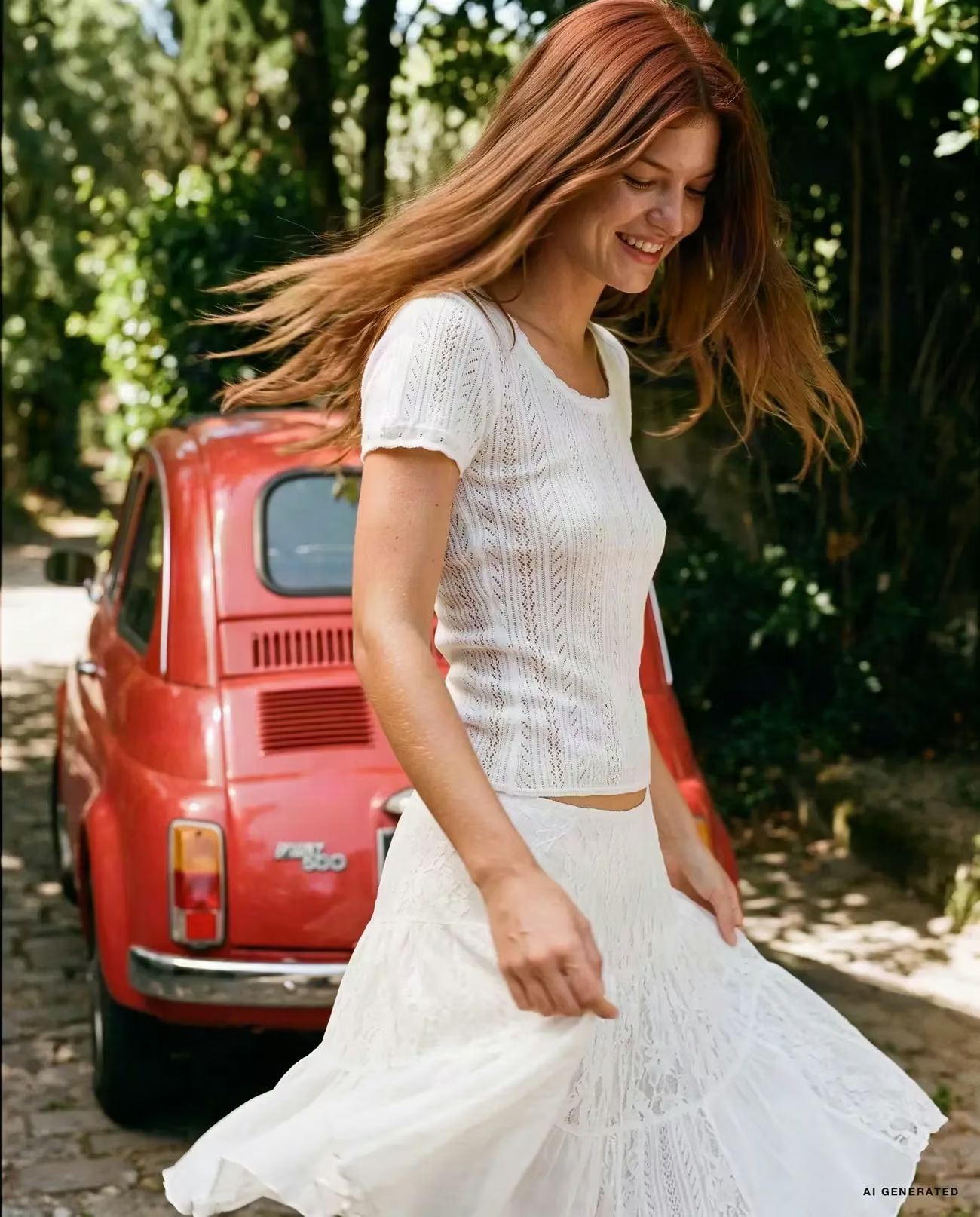
Can you tell?
Only 1 in 4 of us can tell AI from a photograph.
3 in 4 fashion professionals admit they have been fooled. All four images above are AI-generated.
The people who make the images trust their eye least: 18% of marketers and 22% of creatives say they can almost always tell.
The numbers behind the picture
AI imagery is mainstream, cheaper and growing. The label, the owner and the paper trail haven't caught up. Select any figure to read the chapter behind it.
- 67%of fashion companies already publish AI imagery; 32% in regular production.
- 59%of those using AI put synthetic models in their products.
- 65%say more than a quarter of their published photography is AI-modified.
- 66%report a lower cost per image; 28% by more than half.
- 81%expect their share of AI imagery to rise in the next 12 months.
- 26%of fashion professionals say they can almost always tell AI from a photograph.
- 16%of companies using AI imagery always label it. 46% never do.
- 63%would require content provenance from image suppliers. Only 11% use a provenance standard today.
- 36%say no one owns AI-content compliance, or don't know who does.
- 15%could show a regulator today how their AI imagery complies.

01 The new shoot
6 in 10 put synthetic models in their products.
2 in 3 fashion companies already publish AI imagery, and AI has moved from the mood board to the product page. Brands and retailers lead, with 80% already using it. Agencies are the holdouts: half use it, and a quarter have no plans to.
Exhibit 1What companies using AI imagery use it for
Exhibit 2Where they publish it, top five channels

02 Altered, not invented
Most of fashion's AI is altered photography, not generated images.
65% of companies using AI say more than a quarter of their published photography has been AI-modified: backgrounds replaced, garments changed, generative fill. That is the bulk of fashion's AI, and it is the part the labelling rules are least clear about. Fully generated images are a smaller share for most, except on marketplaces, where they are already common.
Exhibit 3Share of published images that are AI-modified photography
Exhibit 4Share of published images that are fully AI-generated

03 The cost of a picture
AI has cut the cost of a fashion image for 2 in 3 companies using it.
More than 1 in 4 have cut it by over half. Not everyone wins: 1 in 11 say costs went up, describing a quick first draft followed by hours of corrections. Volume is heading one way: 4 in 5 will use more AI imagery next year.
Exhibit 5Effect of AI on production cost per image
Exhibit 6Expected share of AI in imagery over the next 12 months

04 The missing label
Fewer than 1 in 6 fashion companies always label AI imagery.
Almost half never do. A third label it sometimes, depending on the channel. Knowing the EU rules apply makes no difference: companies that say they are in scope label no more often than those that don't.
Exhibit 7How often companies using AI imagery label it
- Always 16%
- Sometimes 34%
- Not sure 4%
- Never 46%
Cite this
Fewer than 1 in 6 fashion companies using AI imagery always label it; 46% never do. Source: Modelia, The State of AI-Generated Content in Fashion 2026. https://modelia.ai/research/state-of-ai-content-in-fashion-2026#labelling

05 The new brief
2 in 3 will ask their image suppliers to prove how a picture was made.
1 in 4 already do, or will within a year, and larger companies are moving first. For studios, agencies and photographers, provenance is about to become part of the brief.
Supply isn't ready. Half the industry has never heard of C2PA, the open standard behind Content Credentials: a tamper-evident record of how an image was made and edited, carried in the file. Only 11% use a provenance standard today. Awareness converts, though: two-thirds of those who know C2PA already use a provenance standard or plan to within a year.
Exhibit 8Would you require content provenance from vendors, agencies or suppliers?
Cite this
63% of fashion companies would require content provenance from their image suppliers, but only 11% use a provenance standard today and 50% have never heard of C2PA. Source: Modelia, The State of AI-Generated Content in Fashion 2026. https://modelia.ai/research/state-of-ai-content-in-fashion-2026#procurement

06 Behind the scenes
In 1 in 3 fashion companies, nobody owns the label.
36% say no one is responsible for AI-content compliance, or don't know who is. Where someone is, it's the marketing team more often than legal. Size doesn't help: large companies are just as likely to have no owner.
1 in 7
could show a regulator or partner today how their AI imagery complies. A third couldn't answer at all.
7 in 10
didn't know what getting it wrong costs. EU AI Act fines reach €15M or 3% of global turnover.
Cite this
In 1 in 3 fashion companies (36%), nobody owns AI-content compliance or respondents don't know who does; where someone does, it is more often marketing (27%) than legal (20%). Only 1 in 7 could show a regulator today how their AI imagery complies. Source: Modelia, The State of AI-Generated Content in Fashion 2026. https://modelia.ai/research/state-of-ai-content-in-fashion-2026#ownership
In their words
What keeps fashion teams up at night.
We asked respondents what worries them most about AI imagery. The biggest concern, raised by about 1 in 4, is whether labels and metadata survive once an image is resized, exported or uploaded to a marketplace. Next come product accuracy, supplier accountability, model consent, creative jobs and unclear rules.
“Do the disclosures survive when an image gets reposted?”
“I don’t want customers ordering a version of the garment that doesn’t exist.”
“A supplier saying it’s compliant but not being able to show why.”
“A model agreeing to a photo, not a digital copy of themselves.”
“Do you have to label a background change the same way as a generated model?”
“A cheap image becoming a very expensive mistake.”
07 By region
The US is the most exposed. Europe has the law, not the habit.
The rest of the world is quietly ahead. One thing travels everywhere: in every region, altered photography makes up more than a quarter of the images for around two-thirds of companies using AI.

United States
More than half of companies using AI never label it. Two-thirds don't know the EU's transparency fines exist. The most worried region, and the least prepared.

European Union
The deepest adopters: most in regular production, most synthetic models, most on marketplaces. Yet 6 in 7 using AI imagery don't consistently label it.

Rest of world
Most usage, most fully generated imagery and the best labelling. Adoption here runs on commercial logic, not regulatory fear.
Exhibit 9Three measures by region
Always label AI imagery
Use AI imagery
Would require provenance from suppliers

Get the full report.
51 pages. Free.
- Part IThe executive layerSurvey findings, what Article 50 requires, the dates and the fines, and a readiness playbook with a one-page template.
- Part IINine reference annexesC2PA explained, a channel-by-channel labelling matrix, ten questions for your image vendors, and more.
- Part IIIMethodologyHow the survey was run, and how to cite it.
Methodology
How we ran the survey
How to cite
Modelia, The State of AI-Generated Content in Fashion 2026. Survey of 331 fashion professionals in 29 countries, September 2026. https://modelia.ai/research/state-of-ai-content-in-fashion-2026
- 331 unique responses, 29 countries, September 2026, online questionnaire, English.
- Respondents recruited through two email campaigns to Modelia's global database of fashion professionals, plus organic sharing. No paid panel.
- 31 duplicate submissions (identical answers submitted twice) removed as double-submits. One question (deepfake incident exposure) was not shown to respondents and is excluded.
- Largest markets: United States 36%, EU 34%, Asia-Pacific 22%.
- Questions about how AI imagery is used, what it costs and whether it is labelled (Exhibits 1–7) are reported on respondents who use AI imagery (221 to 223, depending on the question). All other figures are reported on all respondents (328 to 331).
- Regional figures (United States 118, EU 111, rest of world 101 respondents) have a margin of about ±10 points and are best read as a ranking.
- Self-selected sample skewed toward organisations already engaging with AI imagery; usage figures should be read as an upper bound for the industry, compliance figures as a lower bound for the problem.
- Percentages rounded to whole numbers; margin ±5 points at n=331.
- All images on this page are AI-generated and labelled as such.