

In September we asked fashion professionals a set of questions nobody had good numbers on: how much of the industry's imagery is now AI-generated, who labels it, who is ready for the transparency rules that became applicable in August, and who, inside each company, actually owns the question. Today we publish the first findings. The full report is out now, free to download.
Who answered, and how to read the numbers
Between September 19 and 25, 331 professionals completed the survey: brand and marketing leads, e-commerce managers, compliance and legal roles, creatives and photographers, from independent labels to organisations above 1,000 people.
Role split: Marketing/brand 28% · Creative/production 26% · Founder/C-level 18% · E-commerce 12% · Compliance/legal 8% · Other 9%. Organisation size: Just me 18% · 2–10 16% · 11–50 20% · 51–250 15% · 251–1,000 15% · 1,000+ 16%. Respondents in 29 countries. Margin of error ±5 points at 95% confidence (±6 on the AI-user base).
One thing to know before any number: our respondents skew AI-active, because they were reached through the ecosystem of a platform that makes AI imagery. We consider that the point, not a flaw. This is the state of AI content among the professionals already working with it, the population where the rules bite first. If even this group shows the gaps below, the industry-wide picture is not better. Full methodology, question wording and cut rules ship with the report.
Finding one: the disclosure gap
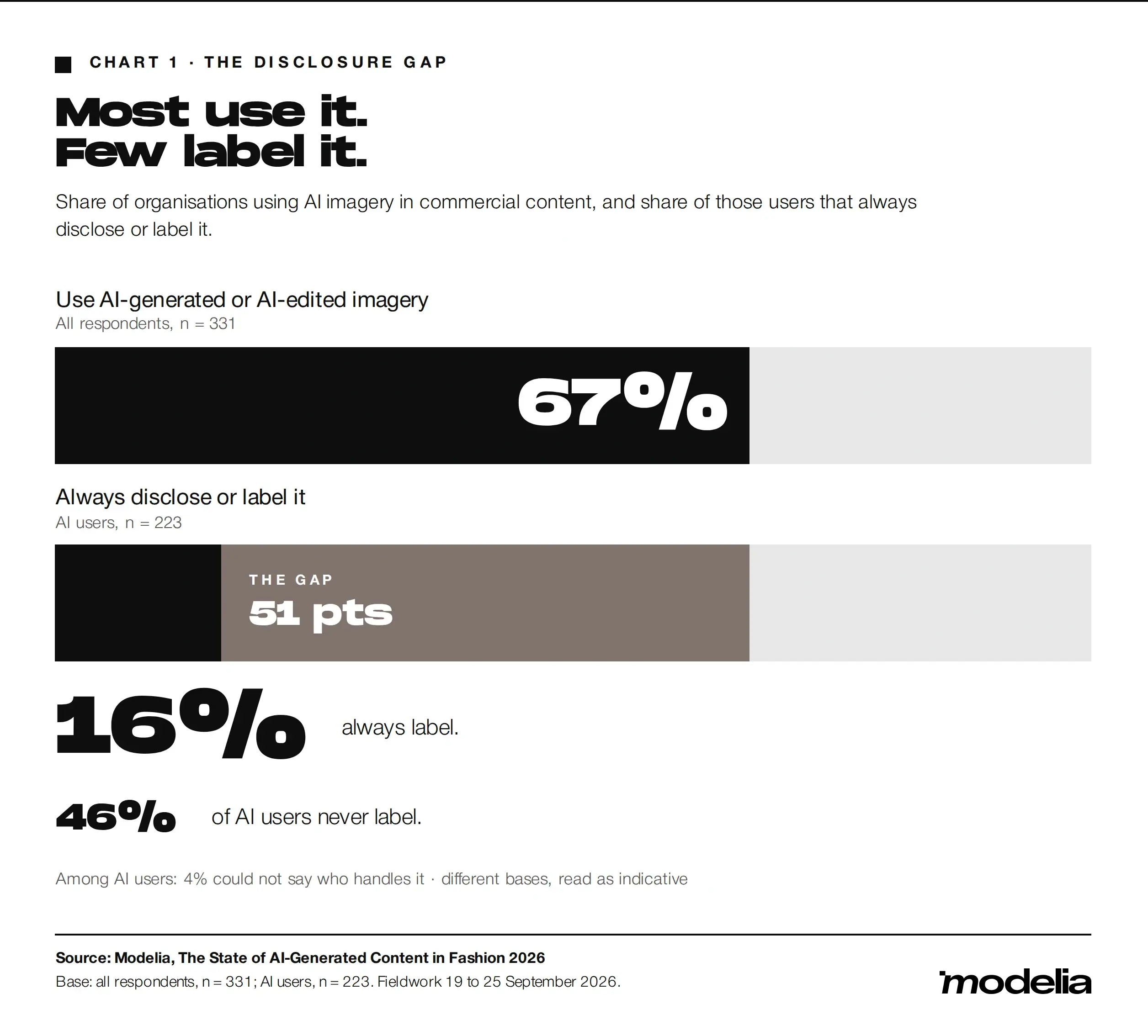
67% of respondents' organisations use AI-generated or AI-edited imagery in commercial content. Among them, only 16% always disclose or label it; 46% never do, and 4% do not know who handles the question.
That distance, between how widely AI imagery is used and how rarely it is consistently labelled, is the single number that best describes autumn 2026. It is not primarily a story of defiance. As the ownership finding below suggests, in many organisations it is a story of a duty that exists in law but has no owner in the building. The legal stakes of that gap are concrete: much of this imagery falls into the category that requires a visible label.
Finding two: the fines nobody has heard of
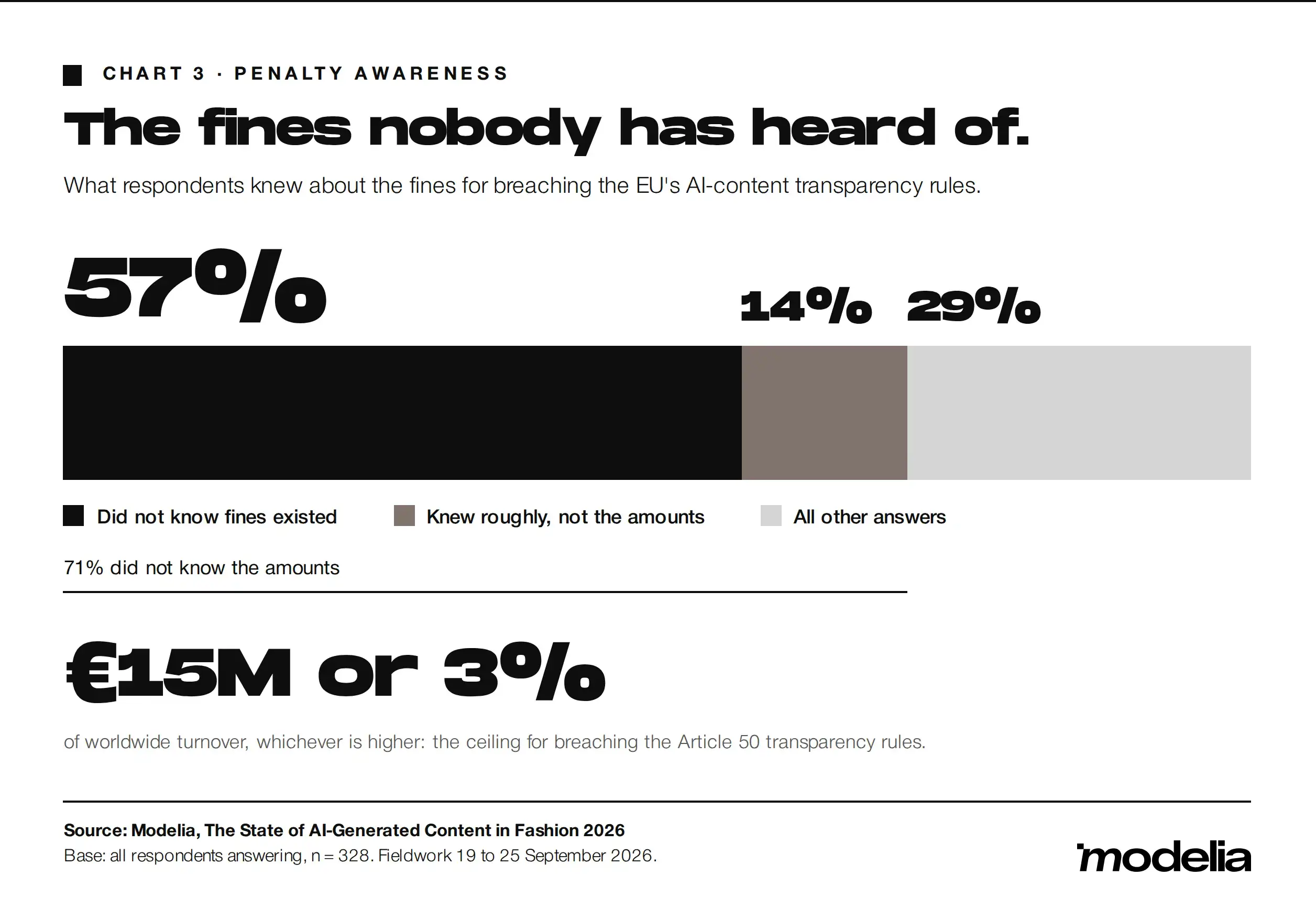
Breaches of the EU's transparency rules can carry fines of up to 15 million euros or 3 percent of worldwide turnover. 71% of respondents did not know the amounts, and 57% did not know fines existed at all.
Read charitably, this is an awareness problem with an obvious fix, and publishing the number is part of the fix. Read practically, it means budget conversations about content compliance are happening, where they happen at all, without the one figure that changes their priority.
Finding three: nobody owns it
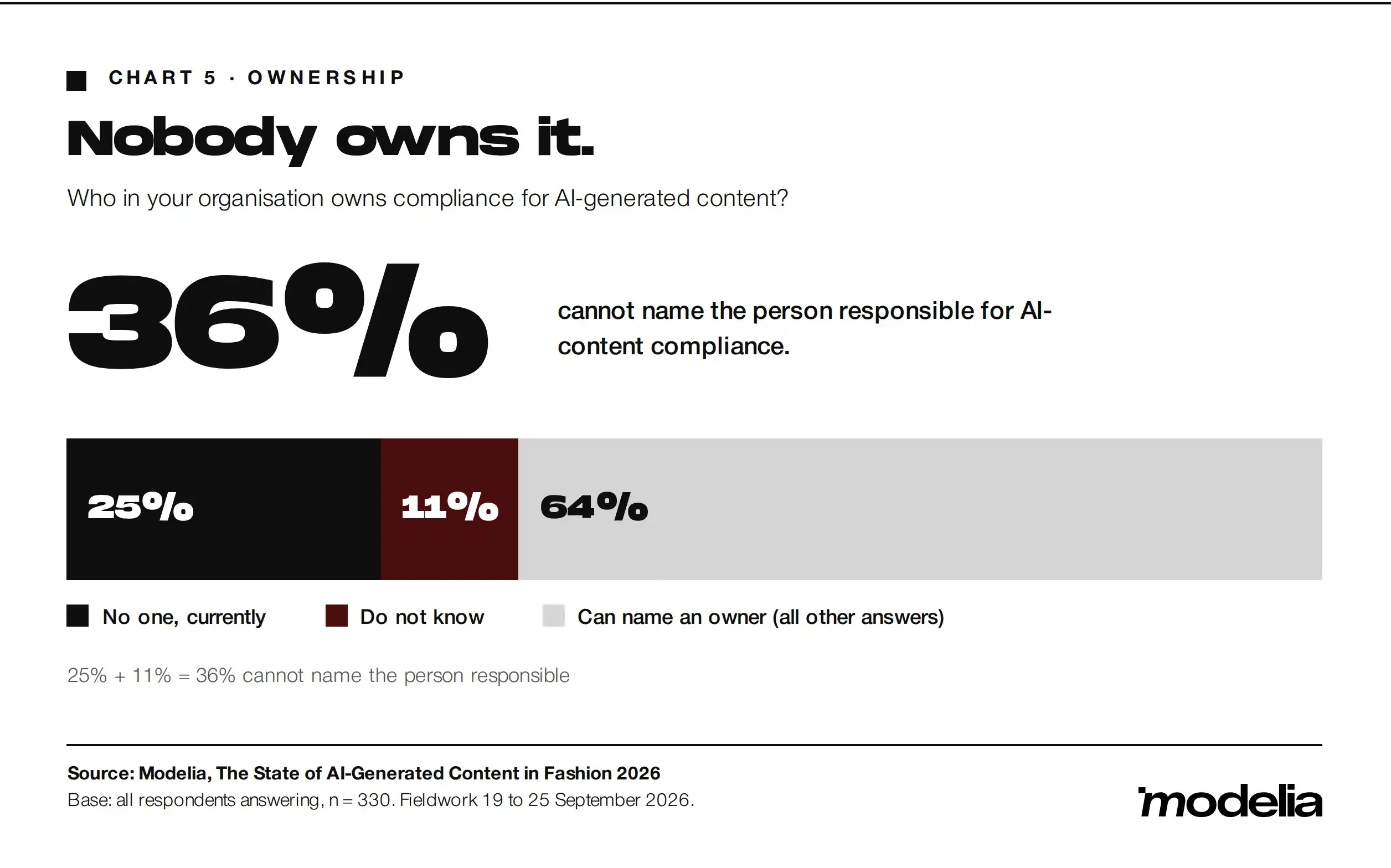
Asked who in their organisation owns compliance for AI-generated content, 25% answered "no one, currently", and another 11% did not know. Combined, 36% of organisations using a regulated technology cannot name the person responsible for the regulation.
Of everything we measured, this is the finding we would put in front of a board. Rules can be learned and labels can be added in a week; both start with a name on the duty. The companies that will answer a regulator's letter in one page are, almost by definition, the ones where somebody owns the page.
What is in the full report
The full report adds what a teaser cannot: the scale numbers (how many images, what share AI-generated, what it did to production costs), the C2PA awareness picture, the procurement shift (who will require provenance from vendors), the 2028 outlook, and the cross-analysis we believe no one else can produce, matching the operations companies actually perform against the marking duties those operations trigger. It is free, and respondents who left their email receive it before public release. Download the full report here.
If the findings above describe your organisation, the fixes are neither expensive nor slow, and most of them are documented in our compliance resources and our plain-language guide to the rules.
These findings come from The State of AI-Generated Content in Fashion 2026, free, with full methodology and every chart. And anything you read here can be tested: check any image in our free public verifier.


