

Fashion marketing has always rewarded creative risk. But in 2026, the brands generating the most attention and the most revenue aren't necessarily those with the biggest production budgets. They're the ones using AI to move faster, personalize deeper, and create content at a scale that was simply impossible three years ago. At Modelia, we work with ecommerce teams and fashion marketing managers every day. We see firsthand which AI campaign ideas for fashion actually perform and which ones stay stuck as interesting concepts. This guide cuts through the hype and gives you concrete, executable AI fashion campaigns you can activate this season with the strategic reasoning behind each one.

Why AI Campaigns Are Reshaping Fashion Marketing in 2026
Before diving into specific ideas, it's worth understanding why ai fashion campaigns have moved from experimental to essential so quickly. The core shift is production speed versus creative ambition. Traditional fashion campaigns require months of planning: concept development, casting, location scouting, shoot days, post-production, and distribution. That timeline made it nearly impossible to respond to trend cycles in real time, let alone test multiple creative directions simultaneously.
AI changes the equation fundamentally. What once took six weeks of production can now be executed in days. That means fashion brands can run more campaigns, test more creative concepts, respond to cultural moments faster, and personalize content for different audience segments without multiplying their budgets proportionally.
The brands that understand this shift are not replacing creativity with AI they're using AI to give their creative teams more runway (no pun intended) to experiment, iterate, and take risks that a constrained production calendar never allowed.
Campaign Idea 1: The Trend Activation Sprint
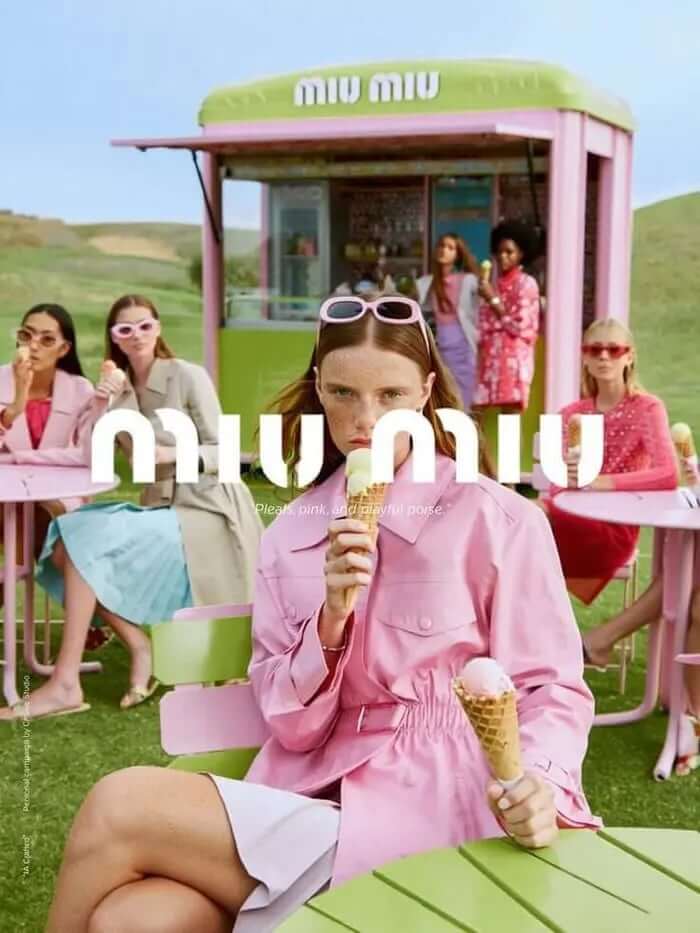
- What it is: A rapid-response campaign that takes a trending aesthetic spotted on the runway, in a viral moment, or surfacing on Pinterest and produces a full visual campaign around it within 72 hours.
- Why it works: Consumer attention aligns with trending aesthetics in real time. When "ballet core" or "dark academia" or "sport luxe" spikes on social search, the brands that publish campaign content immediately capture disproportionate organic reach. By the time competitors brief an agency and book a shoot, the moment has passed.
- How to execute it with AI: Use AI image generation to produce a series of on-model campaign visuals styled around the trending aesthetic, using products already in your catalog. Write campaign copy that mirrors the search language consumers are actually using not fashion industry terminology, but the casual, specific phrases appearing in TikTok captions and Pinterest searches. Publish across paid and organic channels simultaneously.
- What to measure: Track organic impressions and engagement velocity in the first 48 hours. Compare click-through rates on trend-activated campaign content against your baseline campaign performance. Brands running trend activation sprints consistently report two to three times higher engagement rates compared to planned editorial campaigns on the same products, because the content feels culturally immediate rather than pre-packaged.
Campaign Idea 2: The Infinite Lookbook
- What it is: Instead of publishing a single seasonal lookbook with a fixed set of looks, you create a dynamic, continuously updated lookbook that refreshes as trends evolve and new products arrive.
- Why it works: Traditional lookbooks go stale. A Spring lookbook published in February feels dated by April, even though the products it features are still available and actively selling. An AI-powered infinite lookbook solves this by generating new editorial imagery on demand the same products restyled, re-lit, and re-contextualized to stay relevant as the season progresses.
- How to execute it with AI: Build a content template for your lookbook format consistent visual language, model aesthetic, and brand codes and use AI to generate new variations within that template regularly. Modelia's platform allows ecommerce teams to maintain brand consistency across AI-generated imagery while updating styling, backgrounds, and seasonal context without re-shooting. Set a cadence of bi-weekly lookbook updates aligned with trend cycles and new product drops.
- What to measure: Time-on-page for lookbook content, scroll depth, and click-through to product pages. An infinite lookbook should show increasing engagement over time as the content library grows returning visitors should find fresh content every visit, which improves both SEO dwell time signals and direct conversion rates.
Campaign Idea 3: Personalized Visual Storytelling at Scale
- What it is: A campaign that serves different visual creative to different audience segments not just different ad copy, but genuinely different imagery that reflects the aesthetic preferences, body representation, and style identity of each segment.
- Why it works: Fashion is personal. A 28-year-old urban professional and a 45-year-old suburban parent might both be in your target demographic, and both might buy the same product but the campaign visual that resonates with each of them looks completely different. Traditional campaigns force a single creative direction that inevitably underserves large portions of your audience.
- How to execute it with AI: Use your existing customer data to define three to five distinct visual personas within your audience not demographic profiles, but aesthetic profiles. What does each segment's style inspiration look like? What models do they engage with? What environments feel aspirational to them? Then use AI image generation to produce campaign visuals specifically tailored to each persona, featuring the same products but in completely different visual contexts. Deploy these variants across paid social using standard audience segmentation.
- What to measure: Conversion rate by creative variant and audience segment. The most sophisticated fashion brands using personalized AI creative are seeing 20 to 40 percent improvements in paid social conversion rates compared to single-creative campaigns because the imagery feels personally relevant rather than generically aspirational.
Campaign Idea 4: The Virtual Try-On Editorial
- What it is: A campaign format that combines editorial storytelling with interactive virtual try-on functionality allowing consumers to see themselves (or a model that represents them) in your products within the campaign experience itself.
- Why it works: The number one barrier to online fashion purchase is fit and visualization uncertainty. Consumers want to know how a garment will look on a body that resembles their own, in a context that reflects their lifestyle. Traditional campaigns show products on one or two model types in a single context a fraction of the visualization scenarios your customers actually need.
- How to execute it with AI: Structure the campaign in two layers. The first layer is a traditional editorial campaign with AI-generated imagery strong visual storytelling, trend-relevant styling, and compelling copy. The second layer, accessible from the campaign itself, uses AI-powered virtual try-on to let consumers interact with the products directly. The editorial creates aspiration; the try-on creates confidence. Together, they shorten the path from discovery to purchase significantly.
- What to measure: Add-to-cart rate and return rate. Brands that have integrated virtual try-on into campaign experiences report meaningful reductions in return rates in some cases 15 to 25 percent because consumers have higher purchase confidence before they buy. That metric directly impacts profitability, not just revenue.
Campaign Idea 5: AI UGC at Scale
- What it is: A campaign that uses AI to generate realistic lifestyle and social-style content that mimics the aesthetic of organic user-generated content giving your brand the authenticity signals of UGC without depending on customers to create it.
- Why it works: UGC consistently outperforms polished brand content in engagement and conversion metrics because it feels real, unfiltered, and relatable. But collecting, curating, and rights-managing actual UGC at scale is operationally complex, and the quality is inherently inconsistent. AI-generated content that captures the visual language of authentic UGC casual framing, natural lighting, realistic styling imperfections gives marketing teams the performance benefits without the operational overhead.
- How to execute it with AI: Define the specific visual codes of authentic UGC in your category: the aspect ratios, lighting conditions, pose naturalness, and environmental contexts that make content look organic rather than produced. Generate campaign assets within those parameters using AI, then deploy them across paid social as native-feeling content. The key is restraint over-polished AI content reads as artificial immediately. The goal is believable naturalism, not perfection.
- What to measure: Engagement rate and cost-per-click compared to your standard brand creative. UGC-style AI content typically performs significantly better in cost-efficiency metrics on paid social because the platform algorithms favor content that generates organic engagement behaviors saves, shares, and comments which this format reliably drives.
Campaign Idea 6: Seasonal Narrative Campaigns With Real-Time Adaptation
- What it is: A full seasonal campaign built around a coherent narrative concept a story, a world, a character that uses AI to adapt and extend that narrative in real time as the season progresses and new products, trends, and cultural moments emerge.
- Why it works: The most memorable fashion campaigns are not collections of product images they're worlds. Gucci's Alessandro Michele era built an entire aesthetic universe that consumers wanted to inhabit. That kind of narrative depth creates brand loyalty that transactional content never can. AI makes it possible for brands at every level not just luxury houses with unlimited budgets to build and sustain campaign narratives over an entire season.
- How to execute it with AI: Develop the campaign concept and visual language at the start of the season: the story, the mood, the color world, the character archetypes. Use AI image generation to produce the initial campaign assets within that framework. Then, as the season evolves, use AI to extend the narrative new chapters, new products introduced within the same world, responses to cultural moments that fit the campaign's aesthetic. The narrative stays consistent; the content stays fresh.
- What to measure: Brand search volume growth over the campaign period, social follower growth, and email list engagement. Narrative campaigns build brand equity metrics that direct-response campaigns don't and those metrics compound into long-term competitive advantage.
The Strategic Principle Behind Every AI Fashion Campaign
Across all six of these ai fashion campaign ideas, there's a single strategic principle worth naming explicitly: AI is most powerful in fashion marketing when it removes the constraints that force creative compromise.
Budget constraints force brands to produce one campaign instead of six. Timeline constraints force brands to publish seasonal content instead of trend-relevant content. Scale constraints force brands to show one model type instead of many. Production constraints force brands to choose between quality and quantity.
AI removes each of those constraints progressively. And when those constraints are removed, what's left is pure creative and strategic thinking which is where the real competitive advantage in fashion marketing has always lived.
At Modelia, we've built our platform specifically for ecommerce teams and marketing managers who are ready to operate without those constraints. The fashion campaign ideas in this guide are not theoretical they're the workflows our customers are executing right now, this season, while their competitors are still waiting on shoot approvals.
Getting Started: How to Prioritize Your First AI Campaign
If you're new to AI-powered fashion campaigns, the instinct is often to start with the most ambitious idea. Resist that instinct.
Start with the campaign type that addresses your most acute current pain point. If your biggest problem is content velocity you can't publish trend-relevant content fast enough start with the Trend Activation Sprint. If your biggest problem is paid social performance your creative is wearing out and costs are rising start with Personalized Visual Storytelling. If your biggest problem is return rates customers are buying and then sending products back start with the Virtual Try-On Editorial.
Pick one, execute it well, measure it rigorously, and let the results build the internal case for expanding your AI campaign capabilities. Fashion marketing in 2026 rewards the brands that move not the ones that plan perfectly.
The tools are ready. The trends are moving. The only question is whether your content will be there when your customer is looking.


