

Luxury fashion has always sold a promise. Not just a garment, but a world: a set of values, an aesthetic, a sense of belonging to something rarefied and deliberate. Every campaign image, every editorial, every visual asset is part of that promise. Which is why the arrival of AI-generated luxury fashion campaigns is not simply a production story, it is a cultural and strategic one.
Between 2024 and 2026, the industry moved from quiet experimentation to public deployment. The shift is no longer speculative. AI-generated luxury fashion campaigns are here, and the questions the industry is wrestling with, around craft, authenticity, consumer trust, and competitive advantage, are getting more complex by the season.
This article maps the landscape: what the leading houses have actually done, why they are doing it, what has worked, what has not, how you can do it with platforms like Modelia and what it all means for the future of fashion image-making.
Why Luxury Brands Are Turning to AI Now
The timing is not accidental. Luxury brands are producing more content than at any point in their history. A single collection now requires assets for runway, editorial, e-commerce, social media, digital advertising, regional markets, and seasonal extensions. The traditional model, one campaign shoot, one set of images, distributed globally, no longer fits the pace or volume of demand.
At the same time, technology has crossed a threshold. AI image generation in 2022 produced results that were visually interesting but commercially unreliable: distorted hands, inconsistent textures, product details that shifted from frame to frame. By 2024, the output had improved to the point where trained eyes were required to distinguish AI-generated imagery from conventional photography in certain contexts. For e-commerce and social extension assets, where speed and volume matter more than the singular craftsmanship of a hero campaign image, that threshold was enough.
There is also a competitive dimension, "a certain FOMO" driving adoption. Even brands that are deeply protective of their visual identity feel pressure to explore AI, because their peers are doing so, and because standing still while the tools evolve carries its own risk.
According to research published in 2025, luxury brands that integrate AI technologies into their operations are projected to see revenue uplifts of up to 30%. That figure covers a range of applications, personalisation, demand forecasting, logistics, but creative production is increasingly part of the equation.
Gucci: AI as a Creative Brief
In February 2025, Gucci unveiled an AI-generated campaign for its Fall/Winter collection around the theme of duality. Rather than replacing the creative director or the art department, the brand commissioned digital artist Sybille de Saint Louvent to produce the work, using AI as a medium rather than simply a production tool. The result featured mirrored figures and dreamlike environments that extended the runway narrative in ways that conventional photography could not.
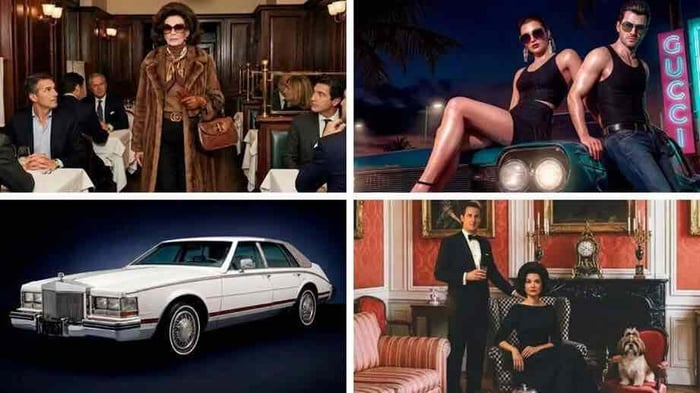
By early 2026, Gucci's use of AI had become more embedded. When Demna Gvasalia made his debut at Milan Fashion Week, the brand released a hybrid campaign it called "Primavera", combining AI-generated visuals with traditional photography, each clearly labelled to indicate its origin. The response was divided. Some observers praised the creative ambition, others questioned whether the AI-generated elements met the standard expected of a house at Gucci's level.
What the Gucci approach illustrates is a model where AI is used to expand creative possibility, not simply to cut costs. The brand is not using AI to avoid hiring photographers. It is using it to produce imagery that sits outside the boundaries of what a conventional shoot can achieve.
Burberry: Archive Revival
Burberry's use of AI in 2025 took a different form. Rather than generating new imagery from scratch, the brand used AI to animate a historical photograph from a 1980s campaign featuring Lord Lichfield in Eastbourne, England, bringing a static archival image to life as a piece of dynamic content.
This is a case study in AI as a heritage tool. For a brand whose identity is built on a 165-year history, the ability to make archive material speak to contemporary audiences without recontextualising or distorting it is genuinely valuable. The core product imagery in Burberry's current campaigns remained rooted in conventional photography. AI was used selectively, for narrative enrichment rather than wholesale replacement.
Valentino: A Cautionary Moment
In December 2025, Valentino released an AI-generated video promoting the Garavani DeVain handbag. The video was clearly labelled as AI-generated and described by the house as a "digital creative project." It featured surreal visuals, bodies and logos morphing around the bag, developed in collaboration with digital artists. All models featured in the original show material had given informed consent for their likenesses to be used.
The Valentino moment became a reference point for the entire industry: a demonstration that labelling AI content does not automatically protect a brand from reputational risk, and that the luxury consumer's relationship with craft and human artistry is not simply a sentimental preference, it is load-bearing to the value proposition.
LVMH: Infrastructure for Scale
LVMH's approach to AI is less about individual campaigns and more about building the infrastructure for sustained, consistent use across its portfolio of brands. The group created what it called an "AI Factory", a centralised capability that supports Dior, Louis Vuitton, Tiffany, and others with tools for demand forecasting, personalisation, and AI-assisted creative production.
In 2024, LVMH awarded its Innovation Prize to FancyTech, a startup that generates high-quality videos from 3D product models, specifically to support e-commerce and campaign content creation. Louis Vuitton's design team began using AI-driven trend analysis to identify emerging aesthetic signals, tracking engagement patterns across global markets to inform collection decisions.
MCM and Jil Sander: Surrealism as Strategy
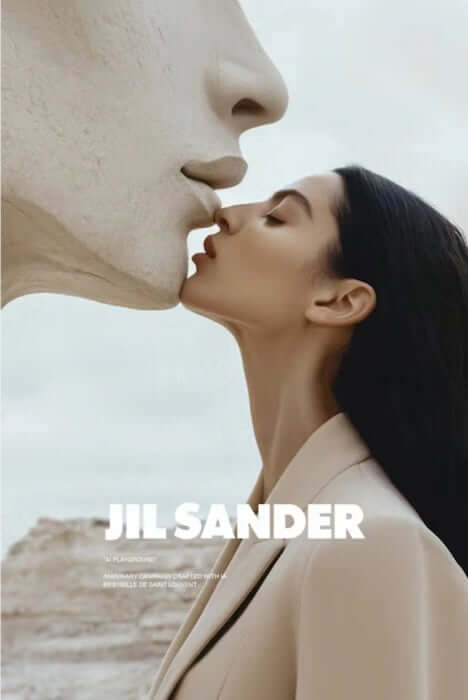
Not every AI-generated luxury fashion campaign reaches for realism. MCM Worldwide used AI imagery in Spring 2025 to create stylised, surreal environments as extensions of traditional shoots, using the technology's capacity for the uncanny rather than trying to simulate conventional photography. Jil Sander incorporated AI-generated visuals into a broader conceptual campaign in February 2025, treating the aesthetic qualities of AI output as a creative choice rather than a compromise.
Both approaches point to a different logic: rather than asking AI to replicate what photography does, these brands used it to produce imagery that photography structurally cannot.
The E-commerce Reality: Scaled, Rarely Disclosed
While headline campaigns attract the most attention, the most widespread use of AI in luxury visual production is happening in a less visible context: e-commerce and product imagery.
Hugo Boss confirmed it has been using AI-generated imagery across e-commerce platforms since 2023. Zalando reported that lots of its editorial images were AI-generated, and the platform leaned further into digital-first catalogues through 2025. H&M rolled out "digital twins" of real models to accelerate campaign production while maintaining brand control over image rights.
This scaled, largely undisclosed use of AI for product imagery is, in many ways, the more consequential shift. Campaign imagery is seen by millions, but it is also a small fraction of the total visual output a brand produces. The product pages, the seasonal refreshes, the localised variants, this is where AI is already operating at volume, changing the economics of fashion imagery in ways that are not yet fully visible to consumers.
Where the Technology Still Falls Short
For all the momentum, there are clear limits to what AI can currently deliver for luxury campaign production.
Product fidelity more broadly is a challenge. Fashion consumers and fashion journalists notice when a bag's hardware is wrong, when a fabric drapes in a way that is physically implausible, when a silhouette has been subtly distorted. General-purpose AI image generation tools are not trained to prioritise these details. Tools built specifically for fashion, like Modelia's AI image generation suite, are designed to understand garment construction, textile behaviour, and product accuracy in ways that matter to the industry.
The Hybrid Model: What Is Actually Working
The practical consensus emerging from the industry is not AI versus photography, it is AI as an extension of photography.
This hybrid model, using a conventional shoot as the creative and technical anchor, then using AI to extend the asset library for specific channels, formats, or regional variants, avoids most of the risks associated with fully AI-native campaigns while capturing much of the efficiency benefit.
The brands using this model effectively tend to share certain characteristics. They treat AI as a production layer, not a creative replacement. They maintain human creative direction throughout, the AI produces variations on a defined aesthetic, not open-ended interpretations. They are transparent with their teams, partners, and increasingly their consumers about where AI has been used. And they use AI tools built specifically for fashion rather than general-purpose generators.
What This Means for the Future of Luxury Visual Production
The direction of travel is clear. AI-generated luxury fashion campaigns will become more common, more technically capable, and more integrated into standard creative production workflows. The question is not whether luxury brands will use AI, but how they will define the boundaries of that use, and how they will communicate those boundaries to consumers who are paying for a promise that human artistry remains at the centre.
The brands that navigate this well will be those that use AI to amplify human creativity rather than replace it. The creative director, the art director, the photographer, the stylist, these are not roles that AI can absorb. They are the roles that define the vision that AI is then asked to extend, iterate, and scale. Elevate your visuals with Modelia
For fashion designers working earlier in the process, at the concept and design stage, before a campaign is ever briefed, tools like Modelia's AI image generation suite offer a different kind of value. The ability to turn a sketch into a photorealistic garment image, or to extract technical flats from campaign photography, closes the loop between design intent and visual communication at a stage where the creative stakes are highest and the cost of iteration has traditionally been prohibitive.
The campaign is the end of the visual production chain. AI is changing the beginning of it too.

